Otawalle Black Wolf Fever Epidemic
The Deer KingThe Otawalle Black Wolf Fever Epidemic was the catastrophe that fractured the Ancient Kingdom of Otawalle and shaped the political order that followed. The disease’s history links black wolves and the movement of animals to a lethal epidemic in a crowded capital; the response was to evacuate the uninfected, leave the sick behind, and seal the city off. Centuries later, this history also offers Hohsalle a comparison for assessing a new outbreak without claiming that the two diseases are the same.
Origins and Early Warnings
Otawalle had flourished for thousands of years across a realm that included the salt mine, the Yukata Plains, the Oki District, and the Toga Mountains. Its people were known for medicine, engineering, and the arts. Yet the kingdom’s political foundations were weakened when a strange disease killed most of its able statesmen and then spread as an epidemic. The outbreak, about two and a half centuries before the later events, precipitated the kingdom’s rapid decline; claims that Otawalle’s learning had trespassed on divine territory remained speculation, while the actual cause of the kingdom’s fall had become obscure.
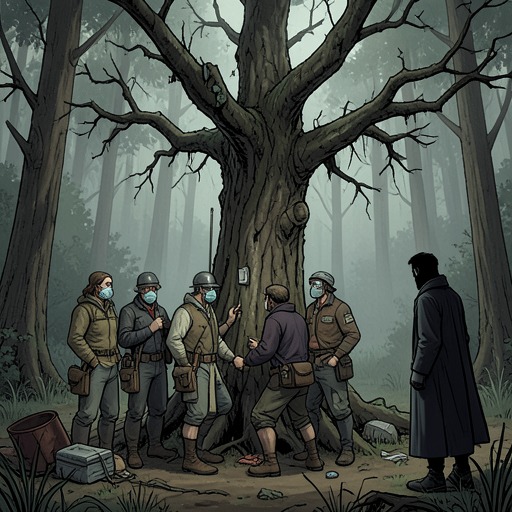
Hohsalle recounts the epidemic through the Ballad of the Fall of Otawalle, whose opening line refers to black shadows coming from white mountain peaks. The phrase describes black wolves, unlike the wolves around the Otawalle capital. According to the historical account he relates, Otawalle noblemen had brought the animals back from the Toga Mountains for sport. The earliest wolves may not have carried disease, but their striking pelts and clever faces made them coveted. Hunters and beast merchants captured and sold them, and some were bred with dogs; demand grew large enough to support merchants specializing in black wolves.
The first warning came in spring, when merchants bitten by the animals developed high fevers and convulsions, followed by rashes and death within roughly a day and a night. The Divine King of Otawalle prohibited the black-wolf trade. The illness then seemed to disappear, only to return as summer approached. This time, victims died in large numbers despite not having been bitten by wolves, revealing that the initial association with bites did not account for the wider outbreak.
Spread Through the Capital
The epidemic took hold during a hot, muggy summer, beginning in the poorest districts, where people lived crowded together, and spreading through the capital. Physicians at the Academy of Deeper Learning proposed a chain of transmission: fleas and ticks that fed on wolves carried the disease onward to rats, multiplying the number of carriers. By the time authorities began exterminating rodents and other pests, thousands had died. The account presents a worsening sequence: animal trade preceded the first recognized cases, the disease appeared to subside after the trade ban, and then a larger outbreak emerged in the capital through a suspected intermediary route.
The geography of the capital magnified both the danger and the possibility of containment. Otawalle’s principal cities stood on three islands in a large inland sea. Their enclosed position had offered strong defense against invasion, but was also thought to have contributed to the plague’s lethality. Once the epidemic spread, the same separation could be used to isolate the infected city from the mainland. The historical narrative thus turns an apparent defensive advantage into a means of quarantining an entire population.
Abandonment and Political Aftermath
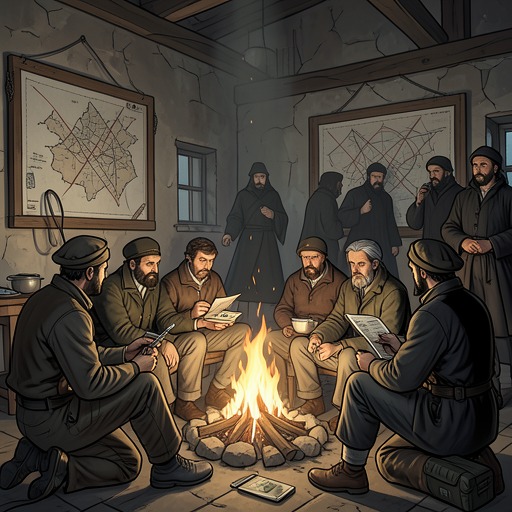
The king’s response was the abandonment of the capital. Takaluhalu left behind the sick and those who refused to leave, destroyed the long bridge linking the capital to the mainland, and withdrew with those not infected. Hohsalle describes the evacuation as a stark separation between those who could escape and those left exposed to the disease. The capital had prospered for a thousand years; its abandonment preserved the uninfected beyond the city while condemning those who remained to a cruel fate.
Takaluhalu then moved the capital to Kazan, a trading city in Aquafa that had escaped the epidemic. He transferred his authority to Kazan’s young Aquafaese ruler in exchange for a pledge to preserve local autonomy for the realm’s diverse peoples. In this way, the Kingdom of Aquafa began in the aftermath of Otawalle’s flight from black wolf fever. The epidemic was therefore not only a medical disaster: it ended the old kingdom’s political continuity and helped create a successor order.
Otawalle’s survivors established the Sacred Territory in a valley ringed by rugged mountains, where they continued to develop medicine and other fields. The Zolians later regarded Otawalle with fear and aversion, while its medical science remained officially branded as heresy even after Otawalle physicians had helped cure the Zolian emperor’s wife. This divided legacy—valued for healing, yet treated as politically and religiously suspect—shaped the later conditions under which Otawalle medicine could be sought and practiced.
A Precedent for Later Investigation
When Hohsalle explains the old epidemic to Yotalu, he distinguishes historical analogy from diagnosis. He cannot confirm that the disease found in the salt mine is black wolf fever, or that the new disease will spread in the same way. In the mine, the victims appeared to have been exposed, developed symptoms, and died almost simultaneously. Because there had been no gradual sequence of cases that would have allowed an early victim to report an outbreak, Hohsalle doubts person-to-person spread.
He also reasons from the outbreak’s aftermath: the disease had acted with great speed, nearly all the exposed people had died, and both enslaved workers and their keepers had been affected, despite the workers’ weakened condition. Yet no one working at the mine after the incident had shown symptoms. Hohsalle therefore considers fleas, ticks, and airborne transmission unlikely in this new case, and tentatively agrees that transmission may occur only through the bite of an animal. He endorses hunting infected animals as a logical precaution and adds that exterminating rats and mice would be prudent. The comparison with Otawalle makes the earlier epidemic useful as a model for asking how disease moves, but does not erase the uncertainty surrounding the salt-mine outbreak.